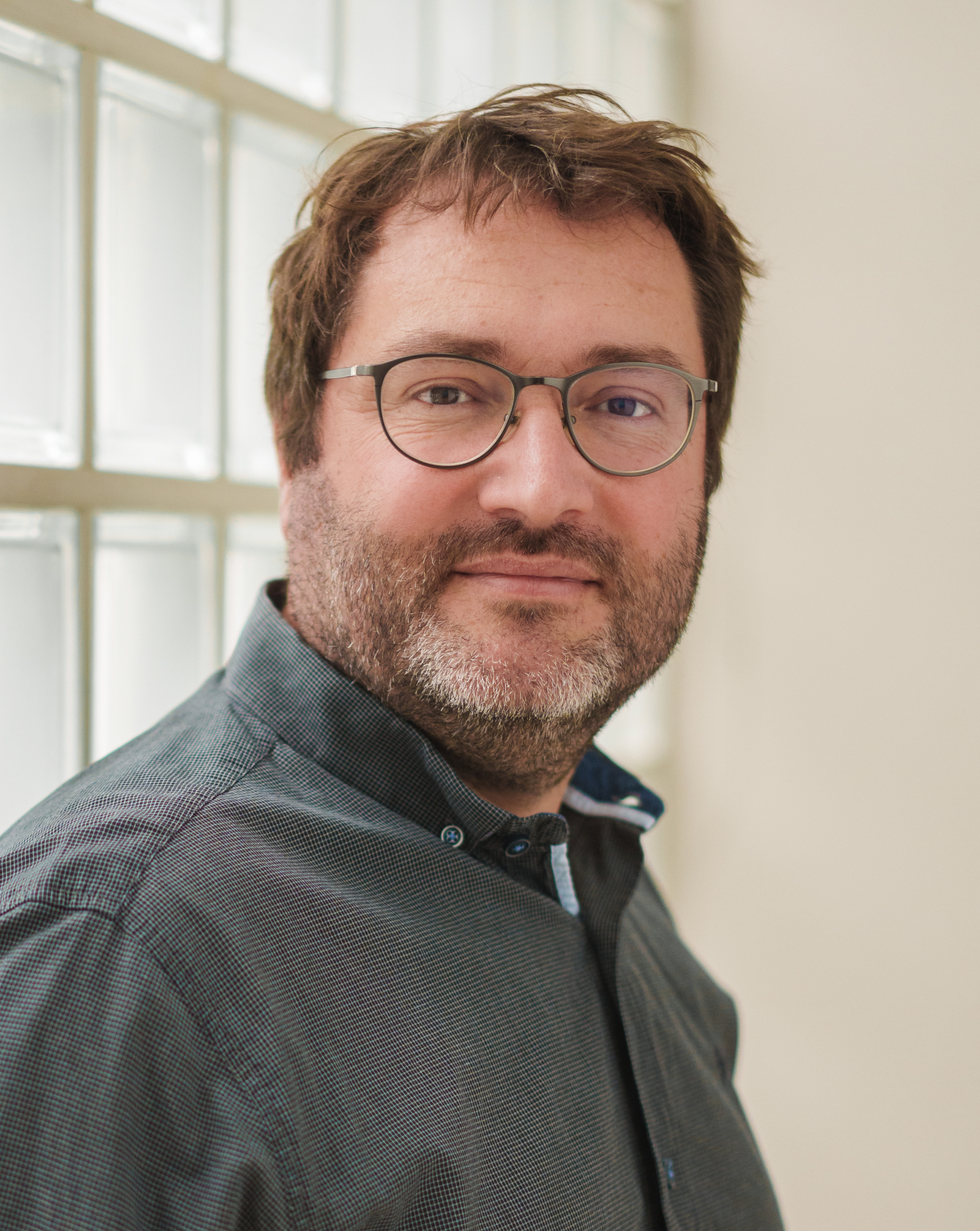

Gildas Avoine


Gildas Avoine

Gildas Avoine is professor of information security and cryptography at the UCL in Louvain-la-Neuve (Belgium), where he leads the Information Security Group (GSI) in the Department of Computing Science and Engineering. Before joining the UCL, he was researcher at the MIT (USA) hosted by Ron Rivest in the CSAIL, and at the EPFL (Switzerland) in the LASEC headed by Serge Vaudenay, where he obtained a PhD degree in cryptography. Previously, he studied at the University of Caen (France) where he received a Bachelor degree in mathematics and Bachelor and Master degrees in computer science.

Gildas Avoine is also an independent expert who leads training and consulting for companies, especially in his favorite field that is security of radio-frequency identification solutions (RFID).

Contact


Information Security Group
UCL /  INGI /  GSI
Place Saint Barbe, 2
Office Réaumur A.142
B-1348 Louvain-la-Neuve
Belgium


Phone: +32 10 47 31 51

Research

My research activities relate to cryptography and information security, especially cryptographic protocols. My recent works addressed fair exchange protocols, time-memory trade-offs, non-adjacent form representations, but also and mostly authentication in radio-frequency (RFID) systems, from both theoretical and practical approaches.

Radio frequency identification (RFID) is a technology that enables to identify objects or subjects with neither physical nor visual contact. For that, a transponder is placed on or in the object to identify and queried remotely by a reader. RFID has been used for many years in applications as diverse as: motorway tolls, ski lifts, identification of livestock and pets, automobile ignition keys, etc. and the boom that it enjoys today rests on the ability to develop very small and cheap transponders called electronic tags. These tags only offer weak computation and storage capacities and so render difficult the task to secure their use. Examples of security issues are: impersonation of a tag to get access to a sensitive building, cloning an RFID-based public transportation card to travel freely, obtaining access to a medical e-dossier record, forging an e-passport, etc. The induced cryptographic challenges consist in designing secure and lighweight building blocks (based either on public-key or secret-key cryptography), and secure and efficient authentication protocols that should assure privacy.

Publications and Presentations

Publications and presentations are available from the Publications section of this website.

Teaching Activities

  • Computer system security (INGI2347), UCL Louvain-la-Neuve (Belgium), Spring.
  • Secured systems engineering (INGI2144), UCL Louvain-la-Neuve (Belgium), Fall.
  • Cryptographic devices (Module A6.2), ENSTA Paris (France), Fall.

Program Committee Member

  • International Conference on Cryptology in India, Indocrypt 2009, India.
  • International Conference on Network and System Security (NSS'09), Australia.
  • Workshop RFID Security Asia, Taiwan, 2009.
  • International IEEE Conference on RFID 2009, Orlando, FL, USA.
  • ACM Conference on Wireless Network Security (WiSec'09), Switzerland.
  • International Conference on Applied Cryptography and Network Security (ACNS'09), France.
  • Conférence sur la Sécurité des Architectures Réseaux et des Systèmes d'Information, 2009, France.
  • Workshop on Artificial Intelligence and Privacy and Security at ARES 2009, Japan.
  • IEEE International Workshop on Cyberspace Safety and Security (CCS'08), Australia.
  • Workshop on RFID Security (RFIDSec 2008), Budapest, Hungary.
  • Workshop on RFID Technology (RFID 2008), Budapest, Hungary.
  • International Workshop on Advances in RFID (AIR 2008), China.
  • Conference Smart Card Research and Advanced Application, (Cardis 2008), UK.
  • Conference on Security and Privacy in Communication Networks, (SecureComm 08), Turkey.
  • Workshop on RFID Security and Privacy (WRSP'08) at ARES 2008, Spain.
  • Workshop on Artificial Intelligence and Privacy and Security at ARES 2008, Spain.
  • Workshop on Privacy at UbiComp, Austria (2007).
  • Workshop on Information Security Applications (WISA 2007), Korea.
  • Workshop on Cryptography over Ad Hoc Networks (WCAN 2007), Poland.
  • Conference on Emerging Security Information, Systems, and Techn. (SECURWARE 07), Spain.
  • Conference on Security and Privacy in Communication Networks (SecureComm 07), France.
  • Workshop on RFID Security (RFIDSec 2007), Malaga, Spain.
  • Workshop on Security and Privacy in Ad hoc and Sensor Networks (ESAS 2007), UK.
  • Workshop on RFID Technology (RFID 2007), Austria.
  • Conference on Information Science and Security (CISS 2007), Korea.
  • Workshop on Pervasive Computing and Communication Security (PerSec 2007), USA.
  • Workshop on Information Security Applications (WISA 2006), Korea.
  • Workshop on RFID Security 2006 (RFIDSec 2006), Austria
  • Conference on Computer Science and Information Systems (IADIS MCCSIS 2006).
  • Symp. sur la Sécurité des Technologies de l'Information et de la Comm. (SSTIC 2004), France.
  • Symp. sur la Sécurité des Technologies de l'Information et de la Comm. (SSTIC 2003), France.